


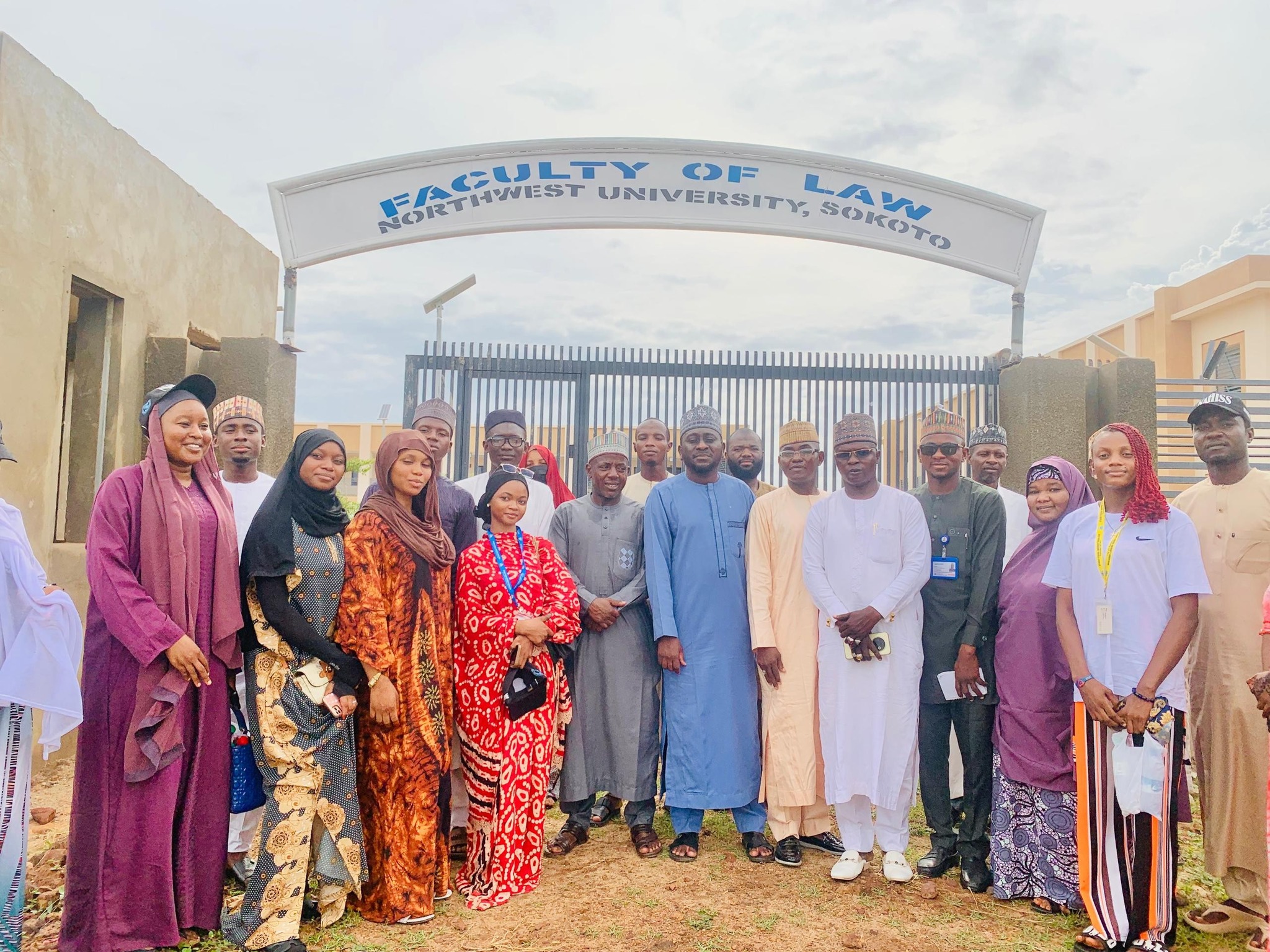
About The Program
The Department of Islamic Law and the Department of Public and Private Law was established in the 2024/2025 academic session under the Faculty of Law. The programme is uniquely structured into two academic departments the Department of Islamic Law and the Department of Public and Privates Law both of which collaboratively contribute to the training of students and the award of a combined Bachelors of Islamic and Common Laws (LLB) degree.
The dual-department structure reflects Nigeria’s plural legal system and is designed to provide students with comprehensive legal education covering both Common Law and Islamic Law traditions. Since its inception, the programme has recorded steady growth in student enrolment and academic activities. The curriculum is developed in full compliance with the National Universities Commission (NUC) Core Curriculum Minimum Academic Standards (CCMAS) and relevant professional requirements, ensuring that graduates are well prepared for the Nigerian Law School and diverse legal careers.
To be a centre of excellence in legal education that integrates Common Law and Islamic Law, producing competent, ethical, and socially responsible graduates committed to justice, the rule of law, and national development.
The mission of the Bachelor of Laws (LLB) programme is to provide quality and integrated legal education through:
- coordinated teaching and scholarship in Common Law and Islamic Law;
- development of critical thinking, legal reasoning, advocacy, and research skills;
- promotion of ethical standards, professionalism, and respect for justice; and
- preparation of graduates for the Nigerian Law School, legal practice, public service, and other law-related careers within Nigeria’s plural legal system.
The entry requirements shall be through any of the two under-listed options:
Indirect (UTME) Mode
The minimum academic requirement is credit level passes in five (5) subjects at O’ Level in the nationally recognised examination, including English Language Literature in English and Islamic Studies obtained at not more than two sittings; such a candidate must, in addition, have an acceptable pass in the UTME.
Direct Entry Mode
1. A two– or three–year Diploma certificate plus credit passes in five (5) papers, including English Language, Literature in English and Islamic Studies at the Senior Secondary School Certificate Examination or General Certificate of Education ‘Ordinary’ Level or their equivalent; or
2. Three (3) papers at the Principal or Advanced Level in Higher School Certificate or GCE together with credit in English Language, English Literature and Islamic Studies in the S.S.S. Certificate Examination or GCE ‘O’ Level or their equivalent, or
3. Two (2) papers at Principal or Advanced Level in HSC or GCE plus credit in three (3) other papers (including English Language, English Literature and Islamic Studies) in S.S.S. Certificate examination or GCE ‘O’ Level or their equivalent.
4. A good honours degree
Program Courses: 123 credits
100 Level
| Course Code | Title | Unit |
|---|---|---|
| GST 111 | Communication in English | 2 Credits |
| GST 112 | Nigerian Peoples and Culture | 2 Credits |
| PUL 101 | Legal Method I | 4 Credits |
| PUL 102 | Legal Method II | 4 Credits |
| LAW 101 | English for Legal Writing | 2 Credits |
| LAW 102 | Introduction to Logic | 2 Credits |
| ICL 101 | Introduction to General Principle of Islamic Law | 2 Credits |
| ICL 104 | Arabic Language for Legal Studies | 3 Credits |
200 Level
| Course Code | Title | Unit |
|---|---|---|
| GST 212 | Logic, Philosophy and Human Existence | 2 Credits |
| ENT 211 | Entrepreneurship and Innovation | 2 Credits |
| PUL 201 | Constitutional Law I | 4 Credits |
| PUL 202 | Constitutional Law II | 4 Credits |
| CIL 201 | Law of Contract I | 4 Credits |
| CIL 202 | Law of Contract II | 4 Credits |
| PUL 203 | Nigerian Legal System I | 4 Credits |
| PUL 204 | Nigerian Legal System II | 4 Credits |
| ICL 201 | Ayat And Hadith Al –Ahkam | 3 Credits |
| ICL 203 | Islamic Law of Crime | 3 Credits |
| ICL 204 | Islamic Law of Torts | 3 Credits |
300 Level
| Course Code | Title | Unit |
|---|---|---|
| GST 312 | Peace and Conflict Resolution | 2 Credits |
| ENT 312 | Venture Creation | 2 Credits |
| PUL 301 | Criminal Law I | 4 Credits |
| PUL 302 | Criminal Law II | 4 Credits |
| PPL 301 | Law of Torts I | 4 Credits |
| PPL 302 | Law of Torts II | 4 Credits |
| CIL 303 | Commercial Law I | 4 Credits |
| CIL 304 | Commercial Law II | 4 Credits |
| ICL 301 | Muamalat (Islamic Law of Transaction) | 3 Credits |
| ICL 304 | Enterprise Appreciation | 2 Credits |
400 level
| Course Code | Title | Unit |
|---|---|---|
| PUL 401 | Law of Evidence I | 4 Credits |
| PUL 402 | Law of Evidence II | 4 Credits |
| PPL 403 | Equity and Trusts I | 4 Credits |
| PPL 404 | Equity and Trusts II | 4 Credits |
| PPL 405 | Property Law I | 4 Credits |
| PPL 406 | Property Law II | 4 Credits |
| CLE 401 | Clinical and Moot Court Practice | 4 Credits |
| CLE 402 | Clinical and Moot Court Practice | 4 Credits |
| ICL 401 | Islamic Property Law | 3 Credits |
| ICL 402 | Islamic Company Law | 3 Credits |
| ICL 403 | Mirath & Wasiyya (Islamic Law of Inheritance) | 3 Credits |
500 level
| Course Code | Title | Unit |
|---|---|---|
| JIL 501 | Jurisprudence and Legal Theory I | 4 Credits |
| JIL 502 | Jurisprudence and Legal Theory II | 4 Credits |
| PPL 501 | Company Law I | 4 Credits |
| PPL 502 | Company Law II | 4 Credits |
| ICL 501 | UsulFiqh (Islamic Jurisprudence) I | 3 Credits |
| ICL 503 | Murafa’at (Islamic law of Evidence & Procedure) | 3 Credits |
| ICL 505 | Application of Sharia in Nigeria | 3 Credits |
| LAW 599 | Long Essay | 6 Credits |